
The End of the Ergonomic Limit: Why Silicon is Growing Limbs
For decades, the “robot revolution” was a digital phantom—lines of code tucked away in server farms or heavy, stationary arms bolted to factory floors. But in the last eighteen months, the narrative has shifted from software to sinew. We are no longer just talking about chatbots that can write poetry; we are witnessing the birth of machines designed to walk, reach, and grip exactly like we do. The goal is no longer to automate a process, but to automate the human form itself. This isn’t just a hardware upgrade; it is a multi-billion-dollar sprint to solve the “labor problem” once and for all, and the stakes involve the very fabric of our global economy.
The urgency is palpable. With aging populations in the West and East Asia creating massive labor shortages, the world’s most powerful tech titans are pivoting. They are betting that the next great platform isn’t a phone or a headset, but a bipedal worker that doesn’t need sleep, healthcare, or a pension. From the glass-walled labs of Silicon Valley to the industrial hubs of China, the race is on to see who can build the first truly “general-purpose” laborer.
The Central Nervous System: How OpenAI and NVIDIA are Giving Metal a Mind
In the past, humanoid robots failed because they were too rigid. They relied on pre-programmed scripts. If a box was two inches to the left of where it was expected to be, the robot would fail. That era ended with the integration of Large Language Models (LLMs) and advanced Generative AI. Now, companies like Figure AI—backed by OpenAI, Microsoft, and NVIDIA—are demonstrating robots that can “reason” through tasks. They can watch a human make coffee, understand the steps, and replicate the movement with eerie precision.
NVIDIA has emerged as a silent kingmaker in this space. Their Project GR00T is a foundation model designed specifically for humanoid robots, allowing them to understand natural language and emulate human movements by observing real-world data. It’s a synthesis of Computer Vision and physical dexterity. When a robot can “see” a cluttered environment and navigate it without a map, the barrier between the digital world and the physical world vanishes. We are moving toward a reality where “hiring” a new worker might simply mean downloading a new skill set into a fleet of machines.
The Tesla Factor and the “General Purpose” Holy Grail
Elon Musk has famously claimed that Tesla‘s future value lies more in its Optimus robot than in its electric vehicles. While Musk is known for hyperbole, the industry is taking the threat seriously. Tesla’s advantage isn’t just in robotics, but in mass production and proprietary battery technology. If Optimus can be manufactured for less than $20,000—the price of a compact car—the economic math for a warehouse manager becomes a no-brainer.
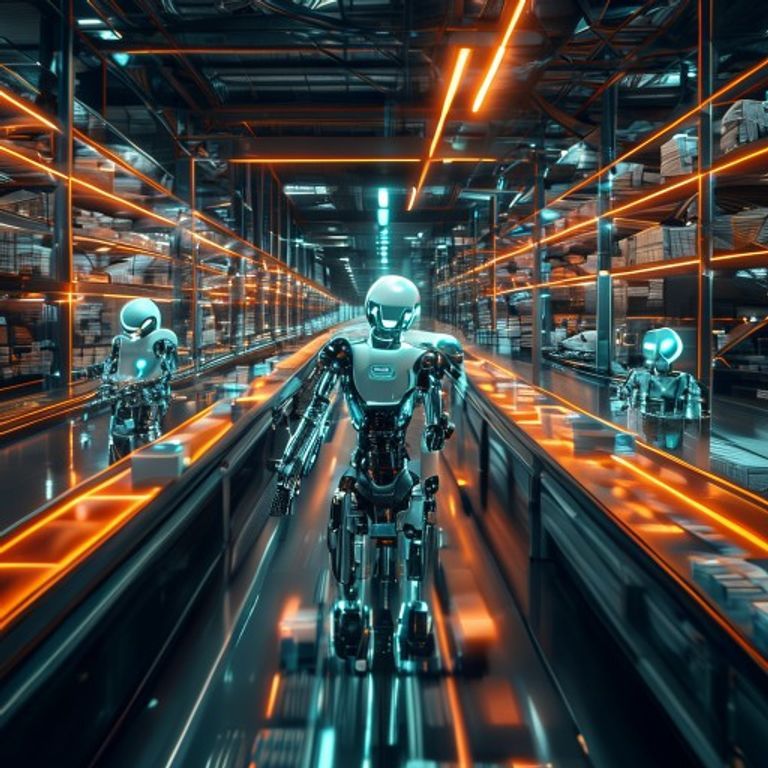
Other heavyweights are not sitting idle. Amazon is already testing Digit, a bipedal robot developed by Agility Robotics, to move empty totes in its fulfillment centers. Unlike the flat-rolling robots of the past, these machines can navigate stairs and reach high shelves, fitting into existing human infrastructure without requiring companies to redesign their entire warehouses. This “drop-in” capability is the secret sauce. Businesses don’t want to rebuild their factories; they want a worker that fits into the world as it currently exists.
Economic Disruption: Will the “Blue-Collar AI” Create a New Class of Unemployed?
The most pressing question isn’t whether the technology will work—it’s what happens to the people it replaces. We often hear that AI will “augment” human work, but humanoid robots are explicitly designed to replace it. In industries like logistics, manufacturing, and even construction, the “human” is often the most expensive and fragile part of the supply chain.
- The Cost Shift: A humanoid robot operates at an hourly “wage” of electricity and maintenance, which is pennies compared to human labor laws and benefits.
- Safety vs. Sovereignty: While robots will undoubtedly take over dangerous “dull, dirty, and dangerous” jobs, they also remove the entry-level rungs of the economic ladder for millions of workers.
- The Reskilling Myth: While some argue workers will move to higher-level roles, the speed of this transition may outpace our educational systems’ ability to retrain a 50-year-old forklift driver into a robot fleet manager.
This disruption will likely force a global conversation on Universal Basic Income (UBI) or “robot taxes.” If a company replaces 1,000 workers with 1,000 robots, the productivity stays the same or increases, but the tax base for local communities evaporates. Policymakers are already behind the curve, as the hardware is advancing faster than the legislation can be drafted.
The Privacy and Surveillance Frontier: Eyes Everywhere
Beyond the job market, there is a looming concern regarding surveillance. A humanoid robot is essentially a walking array of high-definition cameras, microphones, and sensors. In a factory setting, this might be used for “performance optimization,” but as these machines move into retail or domestic environments, the data they collect becomes incredibly sensitive.
Imagine a robot helper in a hospital or a home. It sees everything. Who owns that data? Does Google or Apple have a record of your private home life because their operating system is powering your domestic bot? The potential for a “surveillance state” on legs is a shadow that follows the industry’s bright promises of convenience. As we integrate these machines into our lives, we are also inviting a level of data harvesting that makes the current smartphone era look private by comparison.
Final Thoughts: The Physicality of the Future
We are entering the “Embodied AI” era. The billion-dollar race to replace labor isn’t just about corporate greed; it’s a response to a world where human labor is becoming scarcer and more expensive. However, the transition will be jarring. We are moving toward a bifurcated economy: one where machines handle the physical world and humans are relegated to high-level creative, emotional, or strategic roles—or, more pessimistically, where humans struggle to find a place in a world built for their mechanical twins.
The next five years will determine if these robots become our greatest tools or our most significant social challenge. One thing is certain: the sound of metal footsteps in the warehouse is no longer a sci-fi trope; it’s the sound of the new economy arriving on time.
Frequently Asked Questions
Will humanoid robots really take my job in the next few years?
While mass replacement isn’t happening tomorrow, industries like warehousing, logistics, and heavy manufacturing will see significant humanoid integration by 2027-2030. High-dexterity roles and service jobs will take longer to automate.
Which company is currently winning the robot race?
It’s a tight race between Tesla (Optimus), Figure AI (backed by OpenAI), and Boston Dynamics (Atlas). Tesla has the edge in manufacturing scale, while Figure has the advantage in advanced AI reasoning capabilities.
Are humanoid robots safe to work alongside humans?
Modern robots use “cobot” technology—sensors that detect human presence and instantly stop or soften movements to prevent injury. However, the long-term safety of autonomous humanoid robots in unpredictable environments is still being heavily researched and regulated.