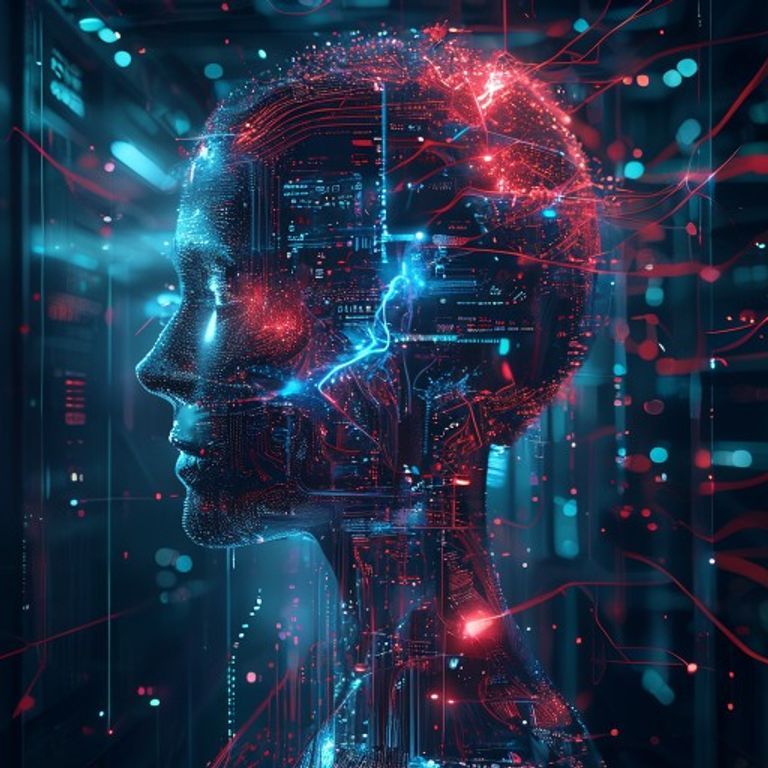

The Invisible Threat: AI-Driven Cyber Risks Explained
Introduction
The digital landscape is currently undergoing a transformation so profound that it rivals the invention of the internet itself. Artificial Intelligence (AI) has moved from the realms of science fiction into the core of our daily operations. However, as we embrace the efficiency and predictive power of large language models and machine learning, a darker shadow is emerging. This is the era of the “invisible threat”—a new generation of cyber risks powered by the very technology designed to help us.
For decades, cybersecurity was a game of cat and mouse played between human intelligence and static code. Today, that dynamic has shifted. We are now witnessing the rise of autonomous, adaptive, and highly sophisticated AI-driven attacks that can bypass traditional security perimeters with chilling precision. These risks are no longer theoretical; they are active, evolving, and targeting everything from global financial institutions to the privacy of individual remote workers.
Understanding these AI-driven cyber risks is not just a task for IT professionals; it is a necessity for every stakeholder in the modern economy. As the barrier to entry for cybercriminals drops and the complexity of their tools increases, we must pull back the curtain on how AI is being weaponized and what it means for the future of digital trust.
Why It Is Trending
The topic of AI-driven cyber risks is dominating headlines and boardroom discussions for several critical reasons. First and foremost is the “Democratization of Cybercrime.” Previously, launching a sophisticated multi-stage cyberattack required a high level of technical expertise. Now, generative AI tools allow even low-level threat actors to write complex malware, craft perfect phishing emails, and identify software vulnerabilities in seconds.
Secondly, the sheer speed of these attacks has reached a breaking point. Human defenders can no longer keep up with the millisecond-scale decision-making of an AI-powered botnet. This “speed-of-light” warfare is forcing organizations to overhaul their entire security architecture, driving massive investment in the cybersecurity sector.
Lastly, high-profile incidents involving deepfakes—AI-generated audio and video—have hit the mainstream news. From viral videos of political figures to sophisticated “voice cloning” scams used to trick corporate treasurers into transferring millions of dollars, the physical reality of AI threats has become impossible to ignore. Governments worldwide are now racing to implement regulations, such as the EU AI Act, specifically to address these burgeoning security concerns.
Key Details
To navigate this new landscape, it is essential to break down the specific vectors through which AI is amplifying cyber risk. The threat is multi-faceted, targeting human psychology, software integrity, and data privacy simultaneously.
- Hyper-Personalized Social Engineering: Traditional phishing emails were often easy to spot due to poor grammar or generic greetings. AI has eliminated these “tells.” Attackers now use LLMs to scrape social media and public data to create highly personalized, context-aware messages that are nearly indistinguishable from legitimate communication.
- Automated Vulnerability Research (AVR): AI models are exceptionally good at scanning millions of lines of code to find “zero-day” vulnerabilities—security flaws that are unknown to the software’s creators. What used to take a team of hackers weeks now takes an AI engine minutes, giving defenders almost no time to patch systems.
- Polymorphic Malware: This is malware that uses AI to change its own code as it spreads. By constantly shifting its signature, it can evade traditional antivirus software that relies on recognizing known patterns of malicious files.
- Deepfake Identity Fraud: Using Generative Adversarial Networks (GANs), attackers can replicate a person’s voice or likeness. This is being used to bypass biometric authentication systems and to conduct “Business Email Compromise” (BEC) attacks at an unprecedented level of sophistication.
- Data Poisoning and Model Evasion: In a meta-twist, attackers are now targeting AI models themselves. By injecting “poisoned” data into a training set, they can create backdoors in a company’s AI, or use “evasion techniques” to trick a security AI into misclassifying a threat as safe.
- Password Cracking at Scale: AI-driven algorithms have become incredibly efficient at predicting passwords based on leaked data and behavioral patterns, rendering traditional 8-character passwords virtually obsolete.
Beyond these specific techniques, there is a systemic risk: the “AI Arms Race.” As defenders deploy AI to catch threats, attackers use AI to learn how to hide from those defenders. This creates a feedback loop where the complexity of the digital environment grows exponentially, often leaving smaller businesses—who lack the resources for high-end AI defense—vulnerable to “collateral damage” from larger-scale conflicts.
Another overlooked detail is the risk of “Shadow AI.” Employees frequently use public AI tools to assist with their work, often inputting sensitive corporate data or proprietary code into these platforms. This data then becomes part of the AI’s training set, potentially leaking trade secrets to the public or to competitors who know how to query the model correctly.
Final Thoughts
The emergence of AI-driven cyber risks represents a paradigm shift in how we perceive digital safety. We are moving away from a world of “static defense” toward a world of “dynamic resilience.” While the threats are daunting, they are not insurmountable. The same technology that empowers the attacker also provides the defender with unprecedented capabilities for anomaly detection, automated incident response, and predictive threat intelligence.
The key to surviving this new era is a “zero-trust” mindset combined with continuous education. Organizations must recognize that traditional security perimeters have evaporated. Security must be baked into every layer of technology, and more importantly, into the culture of the workforce. We must treat AI not just as a tool for efficiency, but as a critical frontier of national and corporate security.
As we move forward, the goal is not to fear AI, but to master it. By staying informed about the evolving nature of these invisible threats, we can build a digital future that is as secure as it is innovative. The battle for the bit-stream has begun, and in this race, awareness is the first and most vital line of defense.